Personal Reflection Without an App: Paper Notes for Rural Days
Personal reflection on paper helps you notice what changes across rural days, without notifications or streaks. Choose a record that suits your attention.
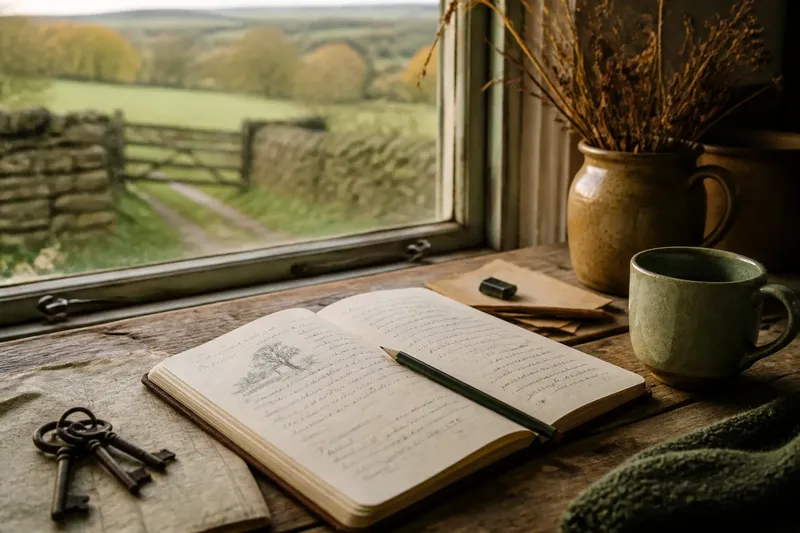
The common mistake with personal reflection is opening a page and waiting for a sudden insight; the cost is mistaking an ordinary note for a failed practice. A dated notebook can hold what an app prompt cannot quite capture: the muddy gate you passed, the wind turning, and the thought that surfaced as you walked home. It asks for attention, not a streak.
A mindfulness app can offer a guided pause, a timer or a reminder. A personal record does a different job: it keeps your own observations and questions together, so you can return to them on your terms. Neither needs to replace the other, but knowing the difference helps you choose what to reach for.
Personal reflection on paper works differently from an app
An app typically gives you a set route: listen, breathe, answer a prompt or follow a session. That can be useful when you want direction in the moment. A notebook has no built-in voice or sequence; you decide what belongs on the page and whether to return to it.
That freedom also asks something of you. Without a notification or prepared exercise, you need a small cue of your own: a notebook beside the kettle, a pencil in your coat pocket, or a question you ask after closing the henhouse. Think of an app as a recorded path through a wood and a notebook as a map you draw from what you notice. The first guides your steps; the second preserves your route.
Paper can also keep reflection close to its setting. You might write beside the kitchen window after checking the rain gauge, or add a note on a bench at the edge of a field. The point is not to make rural life more picturesque; it is to let the place and the thought appear together in your own words.
A dated diary keeps changing days in view
A diary follows time. Its entries can hold a day’s events, a worry, a pleasure or a detail from the land around you. The date offers a simple way back, even when the entry is only a few lines.
Use a diary if you want to notice how an experience shifts. Write what happened, what caught your attention and what remains unresolved. A recurring question such as “What stayed with me today?” can help when the page feels blank, but it need not be answered every time.
For instance, you might record that a neighbour stopped by, the lane was slick underfoot and you felt less troubled about a task after talking it through. The entry does not need to explain why the conversation helped. Later, the date lets you reconnect that feeling with a particular day.
A commonplace book gathers thoughts that arrive out of order
A commonplace book collects fragments rather than following the calendar. You might keep a line from a book, a recipe adjustment, a question raised at the village shop or an observation about the first frost. Add a sentence about why you kept each one; that small link makes the page yours.
Start with a few headings that reflect what you return to, such as “weather”, “work”, “words” or “questions”. If a note fits several headings, choose one and add a cross-reference, or leave an index at the back. Avoid building an elaborate filing system before you know what you actually want to retrieve.
This form suits thoughts that surface while you are mending a gate or waiting for a kettle to boil. Unlike an app’s prompt library, it grows from your own sources and associations. Its limitation is equally clear: without dates or headings, a useful fragment can be hard to find again.
A seasonal record links attention to changes outdoors
A seasonal record can sit between a diary and a collection of fragments. Return to a handful of subjects, such as the state of a footpath, work waiting in the garden, the quality of the evening light or plants flowering near home. Note what you observed and what it brought to mind.
Imagine you feel uneasy about taking on a new responsibility and notice that the lane has firmed after a spell of rain. You write that the ground is easier underfoot, then add that the responsibility feels more manageable than it did earlier in the month. The concrete change gives you a point of comparison, while the note leaves room for the feeling to remain uncertain.
Keep observation distinct from interpretation when that helps. “The ditch is full” describes what you see; “I feel behind” describes your response. Both may belong on the page, but separating them makes it easier to tell what changed outside and what changed in you.
Make a paper practice easy to return to
A notebook does not need a perfect system, but a few practical choices can stop it becoming another chore. Consider how you will use it on wet days, where it will live and whether you want to revisit entries by date or subject.
- Check whether you can reach the notebook where you usually pause; if it is tucked away, then move it beside the kettle or keep a pocket notebook with your coat.
- Check whether writing feels tiring at the end of the day; if it does, then use one short prompt or record a voice note and transfer only what you want to keep.
- Check whether you want to trace events over time; if you do, then date each entry, and if you mainly collect ideas, then use a few plain headings instead.
- Check whether outdoor conditions may damage loose pages; if they might, then use a sturdy notebook and pencil, or keep the main record indoors and jot temporary notes on a scrap.
- Check whether a fragment will make sense when you find it later; if not, then add a few words about where it came from or why it mattered.
- Check whether private writing feels safe in its current place; if it does not, then choose a more discreet location or a format with suitable privacy, and consult someone qualified if your concern involves a serious safety risk.
These are choices, not rules. A pencil, a small notebook and a recurring place to sit may be enough; a phone can still serve as a timer or recorder when paper is inconvenient. The useful distinction is that the record belongs to you, rather than to a sequence of prompts you feel obliged to complete.
Which paper reflection format suits you?
Should I write every day?
Only if a daily rhythm feels helpful rather than compulsory. A sentence on a day you choose can be more inviting than trying to fill every date.
Can a notebook replace a mindfulness app?
It can replace the app for keeping personal observations, but it does not supply guided exercises or a timer by itself. Keep the app for structured pauses if those help, and use paper when you want to record your own experience.
What should I do if I lose track of old entries?
Choose one retrieval aid that matches how you think: dates, a short index or a few headings. If searching becomes more effort than writing, simplify the system rather than adding more categories.
What if I stop writing for a while?
Leave the gap as it is and begin again with the day in front of you. Add a note about the pause only if it helps explain what you want to remember.
Keep the record open to change
Personal reflection does not require every feeling to become a lesson. A page can hold a question, a practical observation or a detail whose meaning is not yet clear. You may understand it differently later, or decide it no longer needs your attention.
Choose personal reflection on paper when you want your own observations to sit beside the date, place and weather that shaped them. Use an app when its guidance is what you need, and combine the two if that feels natural. Before closing a notebook, leave one question for your next return; it gives a future entry somewhere to begin.